The real math on delivery apps
Third-Party Delivery Is Killing Your Restaurant
You think you're paying 20%. You're really paying 30–40% — and it's quietly erasing your profit, your prices, and your customers.
By Tony11 min read
Ask most owners what the delivery apps cost them and you'll hear the same number: "fifteen, maybe twenty percent." That's the number on the contract. It is not the number that leaves your account.
Once you add up everything the apps actually charge — commission, payment processing, "marketing," promotions, and the refunds you quietly eat — independent 2026 cost breakdowns put the real, all-in cost of a marketplace order at 30% to 40% of the ticket (Rezku, ActiveMenus). On a $100 order, that's $30 to $40 gone before you've paid for a single ingredient.
That's not an inconvenience. Run it against how restaurants actually make money and it's the difference between a good year and locking the doors.
"It's only 20%" is the first lie
The headline commission is real, but it's the smallest part of the bill. Depending on the tier you're on, the marketplaces charge 15% to 30% commission per order (Rezku, OPA!). Then, on top of that:
- Payment processing — roughly another 2.9–3% of every order.
- "Marketing" and sponsored placement — pay-to-play just to show up in a search you'd have won anyway.
- Promotions — "free delivery" and BOGO deals that come straight out of your side.
- Refunds and chargebacks — when something goes wrong on their driver's watch, you often eat it.
Stack it all and the advertised 20% becomes a real 30–40% of the order. That's the number that matters.
Now run it against a real margin
Here's the part the apps never put on a slide. Their cut doesn't come out of your revenue — it comes out of the thin sliver of revenue you actually keep. And that sliver is thin: the National Restaurant Association's State of the Restaurant Industry 2025 puts the median net margin at 2.8% for full-service and 4.0% for limited-service restaurants (NRA). Most independents live at 3–5% (Toast).
So do the math on your own restaurant. This is illustrative — run your own numbers — but the shape holds for everyone:
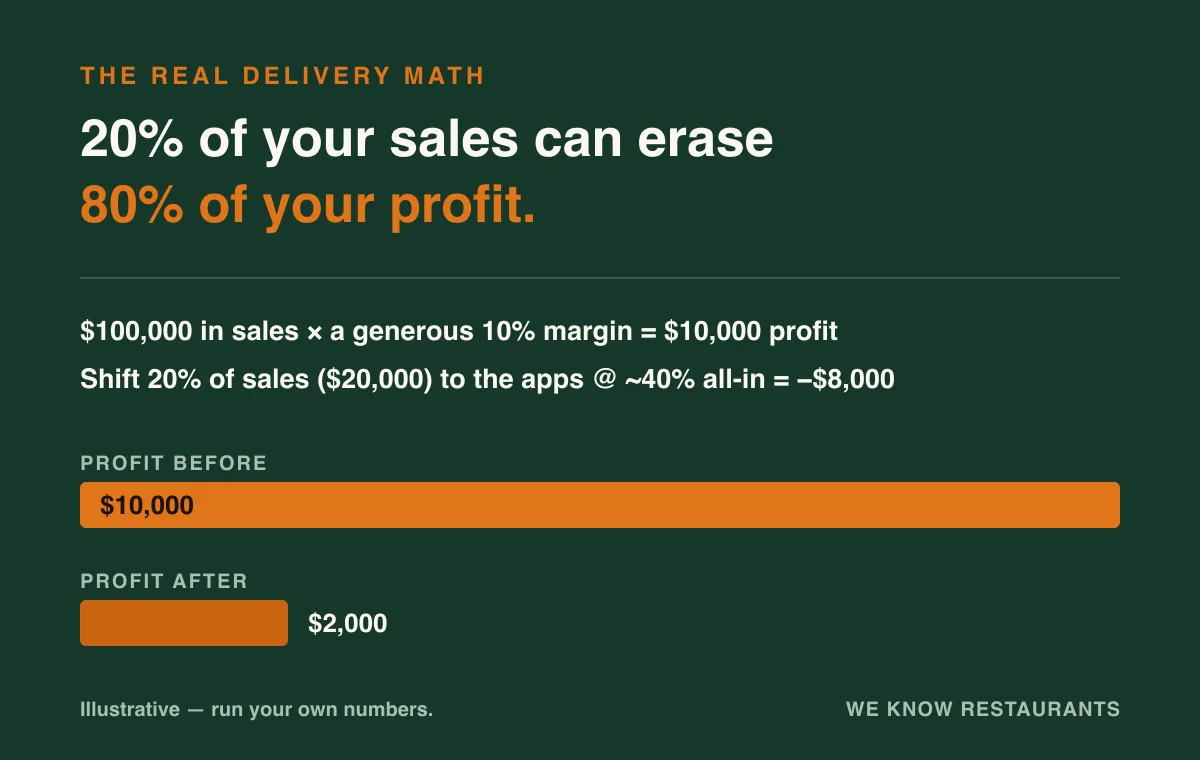
- Say you do $100,000 in sales and run a generous 10% margin. That's $10,000 in profit.
- Now move just 20% of your sales — $20,000 — onto the apps at ~40% all-in. That's $8,000 gone.
- You keep $2,000. One-fifth of your sales just erased four-fifths of your profit.
- And that "generous 10%" is fiction for most kitchens. At a real 3–6% margin, that same shift puts you underwater — you are paying the app for the privilege of selling your own food.
That's why an owner can be "busy" every night, watch sales climb, and still not be able to make rent. The volume is real. The profit left the building with the driver.
The damage doesn't stop at your P&L
Even the orders that don't technically lose money are hurting the rest of your business — because to survive on the apps, you have to raise your prices there. And you have.
Menu prices on the delivery apps now run about 19–20% higher than dine-in on average — a gap that's nearly doubled since 2020, according to Gordon Haskett Research (via Nation's Restaurant News). Add the app's own service and delivery fees on top and the customer can pay a brutal premium over walking in.
Two things happen when your food looks that expensive:
- Guests order less, and order less often. Surveys now show roughly half of consumers have cut back on delivery specifically because of the fees, and a majority say they're spending less on eating out overall (CNBC). Your inflated app price is training your own customers to stay home.
- It's your name on the receipt. The guest doesn't blame DoorDash for the $28 burrito. They blame you.
You don't own a single one of your customers
This is the quiet one, and it's the most expensive over time.
Every delivery order captures a name, an email, a phone number, an address, and a full order history — and all of it stays with the platform, not you. DoorDash's own terms don't hand restaurants first-party customer data (ChowNow, OPA!). You can't email them a coupon. You can't win them back. You can't even see who they are.
And the app isn't promoting you. It's promoting the marketplace. You're one tile in a grid of a thousand restaurants, and their whole business is getting that customer to order again — from anyone — inside their app. You did the hard part. You cooked the food and earned the reputation. Then you handed the relationship to a company whose incentive is to keep that customer for themselves.
And they will not stop at 20%
Watch the trajectory. Tiers keep creeping — Uber Eats' entry commission moved from 15% to 20%, and member-order surcharges keep appearing (OPA!). These are billion-dollar companies answerable to shareholders, and the cut only moves one direction. If this model wins outright, the independent restaurant doesn't make it. That's not fear-mongering. It's the plan, read out loud.
How to take it back
Here's the good news, and it's real: you don't have to quit the apps to stop the bleeding. You have to put them in their place.
- Treat the apps like an ad, not your storefront. Stay on for discovery — new customers do find you there — but stop treating them as your main ordering channel.
- Stand up your own online ordering. When the order comes through your own site, you keep the margin and the customer's information. That's the whole game.
- Price your app menu to cover their cut — so ordering direct is genuinely the better deal for your regulars. That's not greed; it's undoing a markup the app forced onto your menu in the first place.
- Kill the autopilot promos on the apps. Every "free delivery" you run there is you paying to grow their platform.
- Put reservations and loyalty under your own name, and give your regulars a reason to come straight to you.
And your customers are ready for this. A majority say they'd order directly from the restaurant if they could (CNBC). They don't love the fees either. They just need you to give them the door.
Should you run your own delivery? Do the math.
Once you decide to take orders on your own site, the next question is who actually drives the food over. The instinct is "hire my own driver and skip the 30% cut." Sometimes that's exactly right. Sometimes it quietly costs you more than the apps. The only way to know is to run the numbers on your restaurant — so let's.
What in-house delivery really costs. Add up driver wages, fuel and vehicle wear, and the commercial insurance you're supposed to carry, and running your own driver comes out to roughly $10–16 per delivery (UpMenu, Toast). Compare that to the app: on a $40 order, the marketplace takes $12–16 (30–40% all-in). On paper, in-house is a wash-to-win — if you can keep the driver busy.
The number that decides it: idle time. A driver costs the same whether they're on the road or leaning on the pass. So do the math per hour, not per order:
- 1 delivery an hour at ~$18/hr all-in = $18 a delivery. You just rebuilt the app's fee — with none of their reach.
- 3 deliveries an hour = ~$6 a delivery. Now you're beating the 30% cut, keeping the customer, and keeping the data.
So in-house delivery wins when you've got steady volume, a tight radius, and healthy ticket sizes — enough orders to keep a driver moving. It loses when volume is sporadic, your radius is wide, or tickets are small — the idle driver eats the savings. And don't wave off the insurance: a driver in an accident on your clock is your liability, and proper commercial/delivery coverage is a real cost, not a formality.
The move most owners miss: keep the order, rent only the drive. You don't have to choose between "pay 30% to the marketplace" and "hire, manage, and insure your own fleet." There's a third path: take the order on your own site, then dispatch an on-demand courier through a delivery-as-a-service like DoorDash Drive or Uber Direct. You pay a flat per-delivery fee (Drive) or roughly 2.5% + $0.29 (Uber Direct) — not a 30% marketplace commission — and the customer, their data, and your menu prices all stay yours (DoorDash for Merchants). For a lot of restaurants that's the sweet spot: own the relationship, rent only the logistics.
Whatever you choose, charge a delivery fee that actually covers your cost so delivery stops being a loss leader (Toast) — and price it so ordering direct is still the better deal than the app. Run your own drivers when your volume supports it; flat-fee dispatch when it doesn't; the apps only for discovery. That's how you take delivery back without giving away the kitchen.
The bottom line
Third-party delivery isn't free money and it isn't a marketing channel. It's a toll booth on your own food — one that takes 30–40% of the ticket, prices you out of your own market, and keeps your customers for itself. Used carefully, it's a fine way to get discovered. Depended on, it's how good restaurants quietly go under while looking busy.
The fix is ownership: your ordering, your prices, your customers. That's exactly what we build — a real website with online ordering that runs on 0% commission, so every dollar and every customer stays yours. If you want to see the math on your own restaurant, run the free scan or book a no-pitch call.
Take your restaurant back.
Sources
- Net profit margins — National Restaurant Association, State of the Restaurant Industry 2025 (FSR median 2.8%, LSR 4.0%): https://go.restaurant.org/rs/078-ZLA-461/images/SOI-2025-Report.pdf. Cross-check: Toast (3–5% typical).
- Commissions (15–30%) and all-in cost (30–40%) — Rezku, ActiveMenus, OPA!.
- Menu markup vs. dine-in (~19–20%, doubled since 2020) — Gordon Haskett Research via Nation's Restaurant News.
- Consumer fee fatigue / would order direct — CNBC.
- Customer data ownership — ChowNow, OPA!.
- In-house vs. flat-fee delivery economics — UpMenu, Toast, DoorDash for Merchants.
Prices and fee structures change often — quote any vendor's all-in cost in writing, and run the numbers on your own restaurant.